The horse’s memory is excellent, in some ways better than our own. Horses remember places, objects, animals and people very well. Unlike humans, they cannot reflect on memories or deliberately revisit them. Because of this, their memories tend to remain intact over time.
Humans can reflect, reinterpret and revisit past experiences, which can lead to memories becoming distorted. Horses do not have this ability, so what they learn is stored in a much more stable and consistent way.
The horse’s memory is often described as being almost photographic. However, there is an important distinction in how that memory is accessed. Horses cannot recall memories at will. Instead, they access stored memories only when they experience the same or a very similar context again.
This means a horse does not simply “remember” a place or task in isolation. He remembers it when he is back in that environment, or when the situation closely resembles what he has experienced before.
For example, a horse may only remember being in a specific location when he is returned to that location. The memory is tied to the full picture of that experience, not just one element of it.
Why Context Matters in Training
Because the horse’s memory is so closely linked to context, it is important to repeat training in different environments and situations. If training only occurs in one place or under one set of conditions, the horse will strongly associate the behaviour with that specific context.
A clear example of this is float training. If all of a horse’s float training is conducted on the same float, in the same location, the horse may struggle when asked to load onto a different float.
This is not necessarily because the horse is afraid of the new float. Instead, the context of “float training” in his memory only includes that one specific float in that one specific place.
In order for a horse to reliably load onto a variety of floats, he needs multiple experiences across different situations. It generally takes at least five repetitions with different floats for the horse to begin forming a broader understanding of what a float is.
This process is called generalisation.
What Is Generalisation?
Generalisation is the process by which a horse learns to recognise the essential features of something, rather than focusing on every individual detail.
A useful example is introducing a horse to water obstacles. The first water obstacle often takes the longest to negotiate. The second usually takes less time, the third less again, and so on. By the fifth exposure, many horses will confidently go into water regardless of the specific obstacle.
What the horse is doing during those early experiences is recording all the different features of each water obstacle and subconsciously comparing them. Over time, he begins to identify the common element across all of them.
By the fifth experience, the only consistent feature is water itself, and he is able to generalise. At that point, he understands that the task is about going through water, not about the specific shape, colour or surroundings of a particular obstacle.
It is useful to think about generalisation every time you expose your horse to something new.
Context-Specific Learning
Closely related to generalisation is the concept of context-specific learning.
Because of the horse’s photographic memory, he does not just learn the behaviour you are training. He learns everything that is happening around him at the same time.
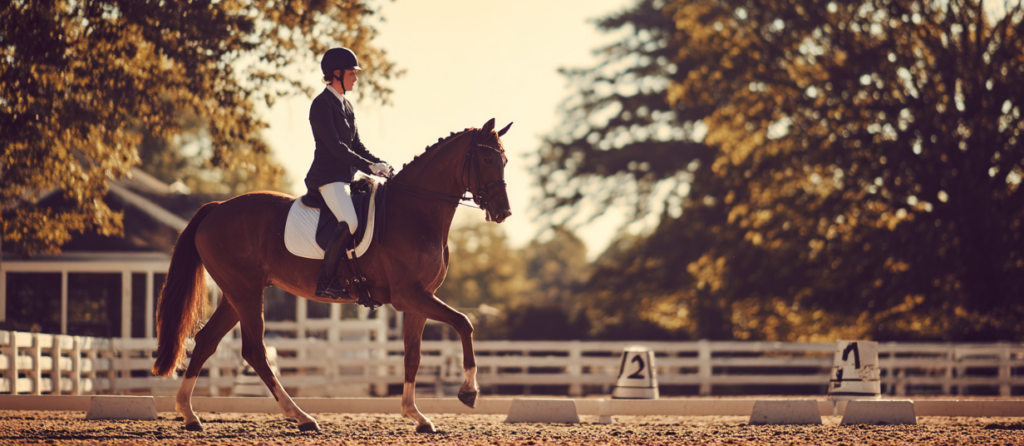
For example, if a horse is only ever trained to jump in a grass arena with striped poles, he may learn that jumping always involves that exact combination. If he is then asked to jump solid coloured poles on a sand surface, he may refuse or become anxious.
This is not disobedience. It is the result of context-specific learning.
The horse has learned:
- The behaviour (jumping)
- The surface (grass)
- The appearance of the poles (striped)
- The surrounding environment (arena layout, fences, trees, markers)
All of these elements become part of the memory.
Because of this, it is important to train in a variety of environments. Horses generally need exposure to at least five different contexts before they begin to understand that the environment is not an essential part of the behaviour, and that the behaviour can occur anywhere.
Practical Takeaways
Understanding how your horse’s memory works has very practical implications for everyday training:
- Horses remember extremely well, but only within context
- They do not generalise automatically
- Repetition in one environment does not guarantee understanding in another
- Variety is essential for creating reliable, transferable behaviour
Why This Matters
When a horse hesitates, refuses, or appears unsure in a new situation, it is easy to assume it is a behavioural issue or a lack of willingness.
In many cases, it is neither.
It is simply that the horse has not yet learned that the behaviour applies outside the original context.
Taking the time to build generalisation and avoid overly narrow, context-specific learning leads to a more confident, adaptable and understanding horse.