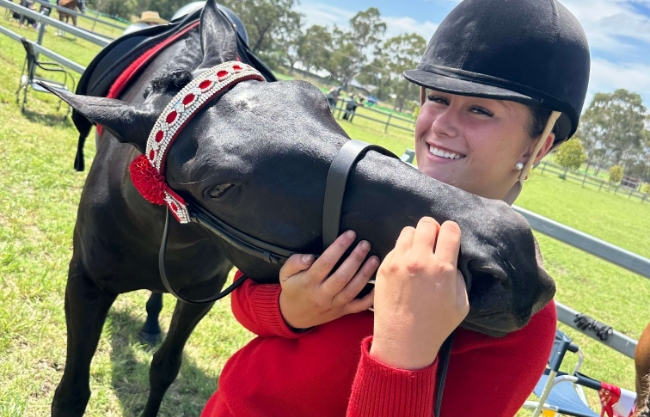
Think about the rides you’ve enjoyed most.
Perhaps you finally mastered something you’d been practising for weeks. Maybe your horse felt particularly responsive, or you came home from a rally feeling that the two of you had really worked well together.
Sometimes the most rewarding moments with our horses have little to do with competition results.
Australian research suggests there’s a good reason for that. And its findings could also help us rethink how we encourage good horse welfare.
What matters most to riders?
A 2023 study published in Anthrozoös surveyed 427 Australian recreational and competitive riders to explore the relationships between horse welfare, rider safety and satisfaction.
Researchers found that three things were closely associated with rider satisfaction:
Achieving their riding goals
Feeling in control while riding
Having a strong partnership with their horse
All three were important, but the horse–rider partnership had the strongest relationship with rider satisfaction.
That’s an interesting finding for anyone who has spent time working towards a riding goal.
We might measure progress by learning a new skill, improving a dressage score or moving up a grade. But the research suggests that the relationship we develop with our horse is an especially important part of what makes riding rewarding.
But the researchers weren’t just interested in what makes riding rewarding. They also wanted to understand whether those same motivations could help encourage better horse welfare practices.
And that raises an interesting question.
We know a lot about horse welfare. So why don’t we always put it into practice?
Today, riders have access to more information about horse welfare than ever before.
Research has improved our understanding of horses’ physical, behavioural and social needs, and there’s no shortage of information about good horse care and training.
But here’s the challenge: knowing what we should do doesn’t necessarily mean we’ll do it.
We all develop habits, and changing established practices isn’t always as simple as learning something new.
The researchers suggest that improving horse welfare may require us to look beyond education alone and consider what motivates riders to change their behaviour.
Their findings offer an interesting starting point.
Riders value making progress, feeling confident and capable, and developing a strong partnership with their horse.
So what if we placed those motivations at the centre of how we talk about welfare?
Of course, every horse deserves good welfare, regardless of whether it improves the rider’s performance, confidence or enjoyment. Providing appropriate care is a fundamental responsibility of horse ownership.
But understanding that responsibility and consistently putting the best available knowledge into practice aren’t always the same thing.
That’s where the research offers an interesting perspective.
If riders are motivated by making progress, feeling confident and developing a strong partnership with their horse, could connecting welfare education to those experiences help encourage positive changes?
It’s not about giving riders another reason to care about their horses. It’s about finding more effective ways to turn that care into everyday decisions and practices.
For example, taking time to develop a horse’s confidence and understanding can support its welfare while also helping develop the partnership its rider values.
Similarly, thoughtful decisions about feeding, management, health and workload support a horse’s wellbeing and provide a foundation for a positive riding experience.
The researchers suggest that understanding rider motivation could help shape more effective approaches to welfare education and behaviour change, although further research is needed to establish how well these approaches work in practice.
Better welfare, safer riding, happier riders
There’s another important reason to consider horse welfare as part of the riding experience.
The study found that riders whose horses had higher relative welfare scores tended to report greater satisfaction.
Horse welfare was also associated with rider safety. Lower welfare scores were linked with more accidents and injuries, while horses showing more behaviours such as bucking, bolting, rearing and spooking were associated with lower rider satisfaction.
The research doesn’t establish that one factor directly causes another. However, it highlights how horse welfare, rider safety and enjoyment are interconnected.
That’s important because welfare is sometimes discussed as though it’s separate from riding performance or achievement.
In reality, these considerations often overlap.
A horse’s health, comfort, management and training all contribute to its welfare, while also forming part of the experience of the person riding it.
Of course, what’s best for the horse won’t always align with what the rider wants to achieve. Sometimes prioritising welfare means changing a training plan, missing a competition or reconsidering a goal.
Those decisions remain important, even when there’s no immediate benefit to the rider.
What can we take from this at Pony Club?
Pony Club gives young people opportunities to develop their riding skills, achieve goals and enjoy competition.
It also teaches them how to care for horses, understand their needs and develop the knowledge and skills to become capable horsepeople.
This research suggests those two parts of the Pony Club experience have more in common than we might think.
If riders value progress, confidence and partnership, then helping them understand how good welfare practices contribute to those experiences could be a valuable way to encourage positive habits.
For coaches, parents and clubs, it’s an opportunity to think about how we explain the importance of horse care and training, not simply what we teach.
And for riders, it’s a reminder that the relationship we develop with our horse is worth investing in, regardless of our ambitions or competition results.
Looking after our horses and getting more enjoyment from riding aren’t competing priorities. They’re closely connected.
Good horse welfare is our responsibility. Understanding what motivates riders may help us become better at delivering it.
Luke, K. L., McAdie, T., Warren-Smith, A. K., & Smith, B. P. (2023). Untangling the Complex Relationships between Horse Welfare, Rider Safety, and Rider Satisfaction. Anthrozoös, 36(4), 721–736.
The study surveyed 427 Australian recreational and competitive riders. Its findings are based on self-reported information and identify statistical associations rather than cause-and-effect relationships. The suggested applications to welfare education and behaviour change require further research.