By Emma Le Grand, Pony Club Australia
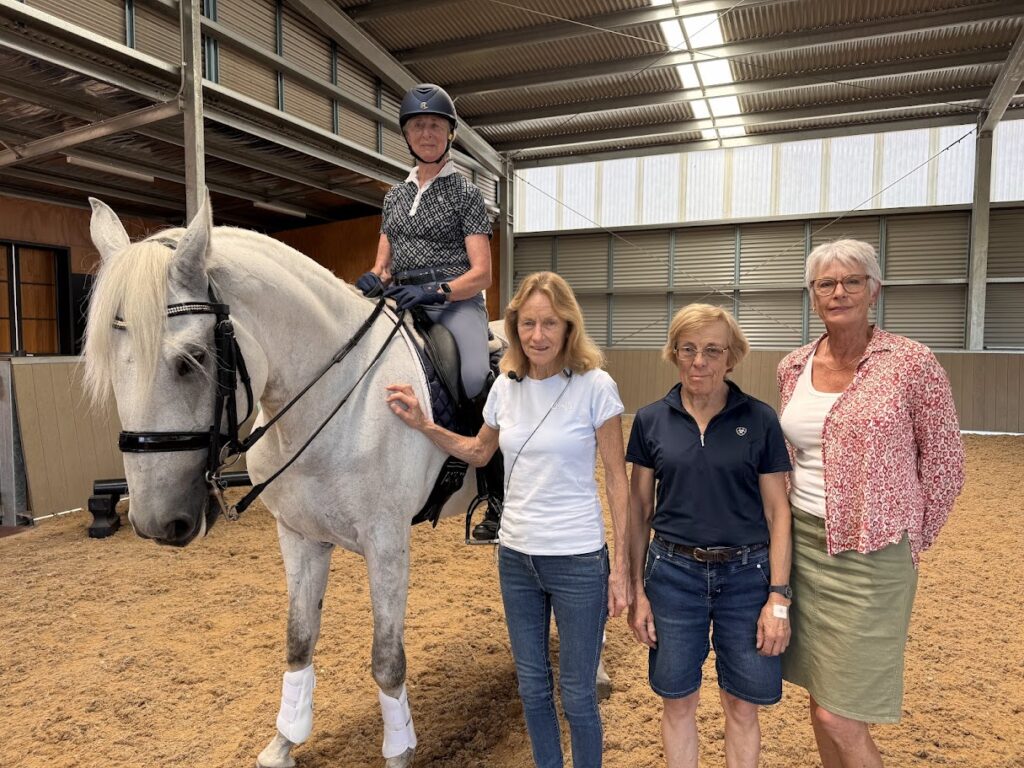
Photo: (l-r) clinic participant and Grand Prix rider Heather Gee with her imported Lusitano gelding, Marques; international dressage judge and trainer Isobel Wessels, Grand Prix rider and coach Debbie Warne, and Grand Prix rider, coach and judge Sue Nevett at Wetterau Equestrian, Ballarat.
Over three days at Wetterau Equestrian near Ballarat, VIC, riders worked with international dressage judge and trainer Isobel Wessels, refining the training of horses ranging from developing young athletes to established Grand Prix partners.
Hosting the clinic was Grand Prix rider and coach Debbie Warne, a Pony Club A Certificate graduate with more than four decades’ experience training dressage horses and riders. Among those observing was Sue Nevett, also a Pony Club A Certificate graduate, Grand Prix dressage rider, Pony Club Level 1 coach, EA Level B Dressage Judge and FEI eventing dressage judge and ground juror.
Together, the three women represent the full spectrum of the sport: grassroots education, high-performance riding and international judging.
Across every lesson, one message came through with striking consistency. Get the basics right. Reward the horse. Create harmony.
They are simple ideas, but they sit at the heart of everything Pony Club aims to develop in riders, from their first lessons through to the highest levels of the sport – practical skills that shape how riders train, respond and make decisions every day.
Different beginnings, shared foundations
Wessels has been involved in riding, training and judging dressage for more than 30 years and is an FEI 5* international judge, the highest level in the sport.
Her philosophy is grounded in classical training. As a teenager living in Vienna, she worked with Ernst Bachinger from the Spanish Riding School, later spending extended periods riding and training in Germany. These experiences shaped her lifelong focus on systematic, correct development.
Despite her elite background, she did not grow up in Pony Club. She trained as a ballet dancer but has long observed Pony Club’s impact.
“I’ve had a bit to do with Pony Club subsequently,” she says.
“I think the virtue of Pony Club is that it’s an all-round education, and members realise that having a pony is a commitment. It’s not just that Mum and Dad will look after it and pay for it and you can just sport around.
“It’s a really good backbone for young ones, taking the tests they have to take, learning stable management, not just gliding around.”
It is structured learning that turns experience into understanding, and understanding into skill.
For Warne and Nevett, that backbone was lived experience. Warne joined Ballarat Pony Club at five. Nevett joined Eltham Pony Club at nine. Both progressed to the pinnacle of the proficiency certificate pathway, foundations that shaped their entire careers.
Nevett’s Pony Club years formed the base of a career that would eventually take her to Grand Prix dressage. Along the way she represented Australia in the 1975 Inter Pacific team in the United States, evented at open level, and later returned to focus on pure dressage, bringing her two horses CC Laurenz and AB Donasoma up to Grand Prix level.
What does “getting the basics right” actually mean?
Throughout the clinic, Wessels repeatedly returned riders to the same place: the training scale.
“It’s going along the lines of the training scale,” she explains.
“The first three parts are rhythm, suppleness and contact.
“You want to see a horse in clear rhythm, a good walk, a bouncy trot and a clear canter. They should be accepting the contact and working through a supple body. That’s the cornerstone.
“Then you build impulsion, straightness and collection. Even if the horse is aimed at eventing or showjumping, you still need those basic things.”
Advanced work is never separate from fundamentals. It is the result of them. For riders, that means knowing what to look for, what to adjust and when to reward: decisions made moment by moment in the saddle.
What makes a rider truly coachable?
Technical ability is not what matters most.
“Riders who are sincere and have a real care for the horse and want to get things right for the right reasons, they are very coachable,” Wessels says.
“Not just papering over the cracks, or wearing all the bling without really doing things properly.
“If you teach somebody, maybe not on the most talented horse, but they really want to get it right and they care, they are very coachable. Most horses then improve. Even a ‘normal’ horse gets better, and the rider feels the benefit of proper training and passion.
“I don’t like teaching people who come one day to me, then go to another coach, and another. They try to find solutions by papering over the cracks rather than getting the fundamental basic things good.”
Sue Nevett sees the same mindset in riders who improve steadily.
“Riders who are happy to listen, happy to ask a question, happy to stop and think, and who make an effort to try to alter something they need to, those are enjoyable to teach.”
That willingness to observe, reflect and adjust is how practical knowledge becomes habit.
From the judge’s perspective: what separates a good test?
Wessels has judged at the highest international level for more than two decades, progressing from 3* to 5* status and officiating at major championships worldwide.
From the centreline, the difference is unmistakable.
“A test, at any level, where there’s harmony and ease and lightness, the horse easily going from one movement to the next, whether it’s complicated or very straightforward, where the horse almost appears to be doing it for itself… those are the special tests,” she says.
“And at any level, the opposite makes it a bad test, when the horse is clearly in trouble, not happy, resistant. That’s what judges do not want to see.”
Nevett agrees and sees the same patterns at Pony Club level.
“Riders and horses that recognise the training directives within Equitation Science International, and understand they need to do the basics before they start more intricate dressage work, those are the ones that progress,” she says.
“They’ve got to have relaxed horses that are fairly supple. It takes commitment, discipline and perseverance. And sometimes the horses riders find themselves on, especially off the track, take more time.
“Regardless of how busy life gets, and the pace of life isn’t slowing down, horses still need time.”
Many marks are lost for surprisingly simple reasons. Often, they are the small technical details riders practise every week.
“Learning the test, making circles the correct size, little things like being able to change their rising diagonal, you can gain a lot of points that way.”
The habit riders forget
Again and again, Wessels reminded riders of something small but critical.
“That’s really important,” she says of rewarding the horse.
“Riders can be very quick to say, ‘come on’, give a kick or a pull, say you shouldn’t have done that. But do they do the opposite? Quite often they don’t.”
Reward tells the horse it has found the right answer. It is a small habit, but one that riders must learn consciously and practise consistently.
Why rider position underpins everything
For Debbie Warne, everything begins with balance, a belief shaped by a lifetime in Pony Club and classical dressage.
Her career has spanned teaching, judging and developing riders at every level, alongside decades of training dressage horses. She also served ten years as Pony Club Victoria Northern Zone DCI and co-wrote the Pony Club Victoria dressage tests introduced in 2007.
Her approach has been strongly influenced by classical training, including years studying with Richard Weis and exposure to the Nuno Oliveira tradition. Her Lusitano stallion Alancelot, imported from Portugal, was trained by Warne to Grand Prix.
In 2019 she established Wetterau Equestrian as a centre for dressage education and international clinics.
From that depth of experience comes a simple conviction.
“Unless the rider is balanced themselves, the horse can’t be,” she says.
“And it’s not very nice for a horse to have someone banging around on them who isn’t in balance. The horse has to put up with that.
“So everything for me is rider position.”
She sees the same patterns repeatedly.
“Mostly riders aren’t balanced over their feet. You should feel as though you’re standing on the ground, not sitting in an armchair. There should be even weight on seat and feet.
“And most people have problems with their arms — too straight, too stiff, not following the mouth.”
Improvement requires guidance.
“Go to a coach who teaches position. You can’t do it on your own. And if your coach doesn’t mention your position at least once in every lesson, they’re not a good coach.
“You never get it 100 per cent. You have to work on it every ride.”
And riders can feel when balance is right.
“If the horse is going along easily, you’re in balance. If you’re pushing, poking and pulling and the horse is tight or falling in and out — you’re not.”
What do the best partnerships always share?
Across disciplines, experience levels and ambitions, all three women returned to the same answer: Harmony. Not as a vague ideal, but as the result of many small skills applied correctly.
“It’s all about harmony and being conscious at every moment about the welfare of the horse,” Wessels says.
“You can tell the riders who care, and the ones who are just doing it for some ulterior motive. The test might be mechanically okay but the missing link is the connection, the empathy between horse and rider.”
That empathy defines exceptional riders.
“The one who has the X factor — it’s not about being spectacular. It’s about empathy with the horse. When they have that, it’s lovely to coach them, lovely to watch them, and lovely to judge them. That’s where you reach the higher mark.
“People think judges want to give low marks — we don’t. We are always happy to give high marks. But it’s got to be right.”
Warne sees it immediately when teaching.
“Good horsemanship is when the rider’s priority is the horse’s comfort and welfare. You can tell that as soon as a rider comes in.”
Nevett connects horsemanship directly to education — and to the way riding culture has changed.
“Understanding the way horses learn — that’s what Pony Club teaches through the proficiency certificate levels,” she says.
“It’s quite a science, and times are different now. Not many riders grow up with parents or grandparents who’ve lived with horses and passed that knowledge down naturally. That intergenerational learning just isn’t there for a lot of people anymore.
“So the horsemanship side has to be taught much more deliberately and much more formally — and that’s where the certificate program becomes so important.”
What lasts
Over three days at Wetterau, the lessons were not dramatic or complicated.
Again and again, riders were brought back to quiet adjustments.
A clearer rhythm.
A softer contact.
A moment of release.
A better balance point.
Small changes with visible results.
From the perspective of an FEI 5* judge who has spent decades at the highest level of the sport, Isobel Wessels kept returning to the same priorities. However advanced the work became, the focus remained on the basics that underpin it, alongside a genuine commitment to the horse.
For Debbie Warne and Sue Nevett, those priorities are not abstract ideals. They are the foundations they grew up with, learned through Pony Club and tested across careers that have taken them from grassroots education to Grand Prix performance and international judging.
Different riders, different horses, different ambitions. But always the same starting point.
In a world where fewer riders grow up surrounded by horses and inherited knowledge, those principles no longer develop by accident. They must be taught deliberately, learned carefully and practised consistently.
That is what Pony Club provides. Not just opportunity, but practical knowledge.
How to ride with balance.
How to reward at the right moment.
How to train systematically.
How to build a partnership step by step.
Watch enough horses and riders, at any level, and the pattern becomes unmistakable.
The partnerships that last are not built on shortcuts or quick fixes. They are built through small skills applied well, day after day.
From the ground up.
- Want to improve your riding position? Join Grand Prix rider and coach Debbie Warne for a Rider Position Clinic at Wetterau Equestrian Centre, Miners Rest (Ballarat), on 18 July 2026.
Cost: $15 per person.
Organised by Horsham Pony Club DC and Midlands Zone Chief Instructor Kylie Fiedler.
Participants will observe demonstration riders while Debbie instructs, corrects and explains — offering practical insights into rider biomechanics, effectiveness and feel.
For more information, email kylie.fiedler@outlook.com