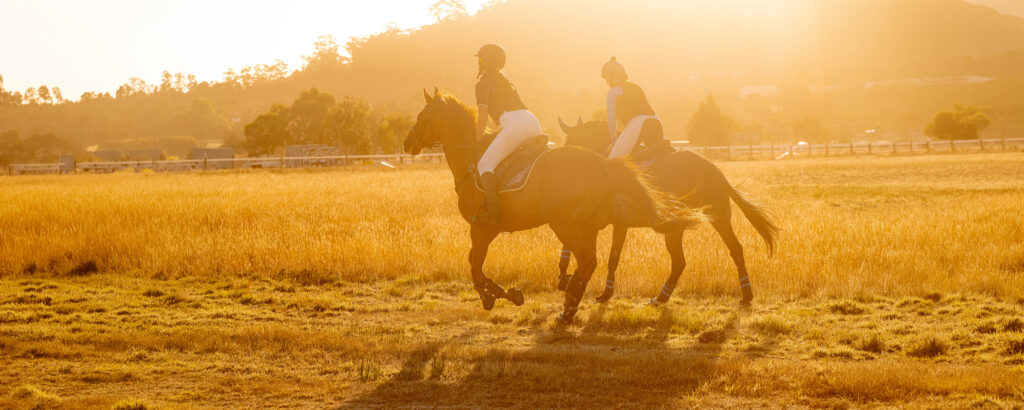
Hot weather poses real welfare risks for both horses and people. Pony Club Australia’s Hot Weather Policy exists to help organisers, coaches, parents and riders make informed decisions on if, when and how Pony Club activities should proceed during periods of high thermal load.
Hot weather affects everyone
Pony Club Australia recognises that hot weather impacts horses, riders, officials, coaches, volunteers, strappers and spectators alike, and welfare decisions must consider all participants — not just those competing.
Why temperature alone is misleading
One of the most common misunderstandings in hot weather management is relying on the forecast temperature alone.
Air temperature only measures “dry bulb” temperature. It does not account for:
- Humidity
- Wind speed
- Cloud cover
Weather apps and forecasts typically report air temperature only, which does not provide an adequate basis for assessing heat risk to horses or people.
WBGT: the correct measure of heat stress
The Wet Bulb Globe Temperature (WBGT) is the best available measure of thermal load. WBGT combines:
- Air temperature
- Relative humidity
- Wind speed
- Cloud cover
This matters because both horses and humans cool themselves primarily through evaporation of sweat, and this process becomes far less effective in high humidity, low wind conditions — even if the temperature does not seem extreme.
The Australian Bureau of Meteorology (BoM) publishes daily WBGT values for regional locations, and these should be used when assessing hot weather risk, rather than relying on temperature alone.
Environmental conditions that increase risk
Horses generally tolerate high temperatures with low humidity and reasonable wind reasonably well. Risk increases significantly when high ambient temperature, high relative humidity, and low wind occur together — creating a high thermal load.
Individual risk factors
Some horses are less able to cope with hot weather, including those:
- Transported in poorly ventilated floats
- That do not sweat freely (“dry coated”)
- With excitable temperaments
- Not acclimatised to local conditions
- That are unfit or overweight
- People are also at increased risk if they are:
- Young (children have less developed sweating mechanisms)
- Exercising at high intensity
- Unwell or heat intolerant
- Wearing heavy clothing or protective equipment
- Unfit or overweight
WBGT-based action levels
Pony Club Australia uses WBGT thresholds to guide decision-making:
- WBGT >33 (EXTREME risk)
Events must be delayed, postponed or cancelled. - WBGT 30–33 (HIGH risk)
Veterinary advice should be sought. Activities should occur before 11am or after 4pm, high-intensity exercise requires aggressive cooling, non-grassed surfaces should be avoided, and courses or formats modified to reduce stress. - WBGT 28–30 (MODERATE risk)
Shade should be used where possible, competition stress reduced, non-grassed surfaces avoided, and adequate cooling facilities provided. - WBGT <28 (LOW risk)
Activities may proceed with good animal welfare practices.
Facilities and grounds on hot days
On days of elevated WBGT, organisers should ensure:
- Horses are stabled out of the sun in well-ventilated areas
- At least two wash bays with hoses are available
- Water supply is sufficient for repeated, thorough cooling
- Ice, scrapers, sponges and towels are accessible
- Shade is provided for horses, riders, officials and spectators
- Horse participation in presentation ceremonies is reduced.
Managing exercise and recovery
During high WBGT conditions, strenuous exercise lasting more than six minutes is high risk for horses. Event formats, warm-up times and competition schedules should be adjusted accordingly.
Signs of heat stress in horses include:
- Elevated temperature 30 minutes after exercise
- Rapid, shallow breathing with flared nostrils
- Poor recovery
- Dehydration
- Agitation or distress
- Excessive sweating — or absence of sweating.
Cooling horses effectively
Cooling should maximise evaporative heat loss, including:
- “Wet and walk” in shaded, well-ventilated areas
- Buckets or sponging with iced water if heat affected
- Allowing horses to drink freely at ambient temperature
- Ensuring horses are fully cool before loading onto a well-ventilated float.
Heat stress in people
Warning signs include:
- Dizziness or confusion
- Headache
- Poor coordination
- Pale or ashen skin
- Collapse or fainting
- These may indicate heat stroke, which is a medical emergency.
People should maintain regular fluid intake, avoid alcohol, caffeine and sugar, seek shade and ventilation, and use electrolytes if sweating heavily.
The key takeaway
Do not rely on temperature alone.
Hot weather welfare decisions must be based on WBGT, not the number on a weather app. Confusing the two is common — and it can lead to underestimating risk to both horses and people.
Pony Club Australia’s Hot Weather Policy provides clear, evidence-based guidance to help protect welfare when conditions become challenging.